
Buncombe County Criminal Court Files
A Buncombe County criminal court record begins when a criminal case is opened in the court system. It is maintained through the Clerk of Superior Court and the statewide eCourts system, not by the jail as a custody roster. The case file can contain charging documents, the docket, hearing dates, pleas, motions, orders, disposition, sentence, probation terms, restitution, fines, costs, bond events, failure-to-appear events, and appeal entries. For the charge pathway before a final case outcome, use Buncombe County arrest records and court charges.
Superior Court and District Court both matter. Superior Court is the primary trial court for felony criminal cases. District Court handles many misdemeanors, infractions, traffic matters, and first-level criminal proceedings. Buncombe County is identified by the Judicial Branch as Prosecutorial District 40, Superior Court District 40, and District Court District 40. The Clerk of Superior Court is the county-level record office for the resulting case files.
The official North Carolina criminal cases help topic is the source for many case-process details.
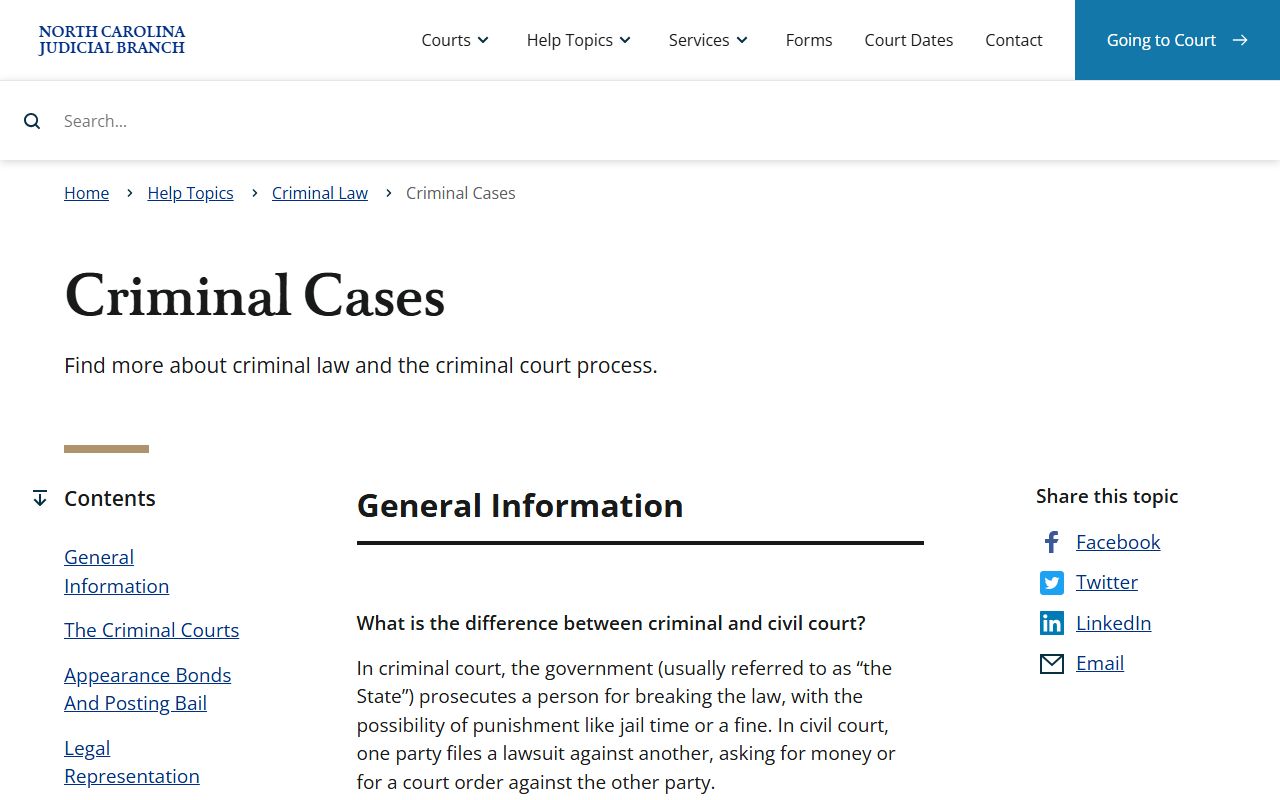
That state help material frames criminal court records as a court process, distinct from jail custody or law-enforcement incident files.
Search Buncombe County Criminal Court Records
The primary online path is eCourts Smart Search. Use a case number when known, or a defendant name in last, first middle suffix format. Advanced filters can narrow by Buncombe County, case type, case status, date of birth, file date, or party details. Search Hearings is the better tool when the immediate need is a court date, hearing type, courtroom, attorney, judicial officer, or calendar entry.
- Open the eCourts Portal and choose Smart Search for case information.
- Search by defendant name or case number, using Buncombe County as a location filter when needed.
- Check the case type, status, charges, docket entries, and disposition before relying on a result.
- Use Search Hearings if the need is a future criminal court date or courtroom setting.
- Request certified copies or review paper files through the Clerk of Superior Court when the portal summary is not enough.
Public terminals are an important fallback. The Judicial Branch says criminal case information can be searched at a public self-service terminal in any county clerk's office by defendant name, case number, or victim or witness name. Paper files must be viewed at the clerk's office in the county where the case is located. For Buncombe cases, that means the Clerk of Superior Court at 60 Court Plaza.
Buncombe County Criminal Case Flow
A criminal court record grows as the case moves. A charge may begin with a warrant, citation, indictment, or other charging document. The court record then adds the first appearance or arraignment activity, pretrial motions, hearings, continuances, plea activity, trial results, disposition, sentencing, and later events such as probation matters, bond forfeiture, failure to appear, or appeal. Each step may appear as a docket event even when the full document is not available online.
Case flow: Charges Filed › Arraignment › Pretrial and Motions › Plea or Trial › Disposition › Sentencing
| Stage | What the Record May Show |
|---|---|
| Charges filed | Offense name, statute or code if present, severity, filing date, docket number, and bond information. |
| Arraignment | Formal charge and plea activity when reflected in the docket. |
| Pretrial and motions | Continuances, motions, orders, attorney appearances, and scheduled hearings. |
| Plea or trial | Plea entry, verdict, dismissal, not guilty finding, or other case outcome. |
| Disposition | Final outcome such as guilty, dismissed, not guilty, responsible, or judgment entered. |
| Sentencing | Sentence, probation, fines, costs, restitution, jail or prison term, and related orders where public. |
What Buncombe County Criminal Records Show
A criminal case file is broader than a charge list. It may show the court, case number, defendant, attorney, prosecutor, charges, bond, hearings, motions, plea, disposition, sentence, costs, restitution, and appeal activity. It may also show an order for arrest or failure-to-appear entry. Some personal identifiers are redacted, and some documents may require clerk access rather than portal viewing.
| Field | What It Shows |
|---|---|
| Case number | Year prefix and case-type letters, such as CR for at least one criminal offense. |
| Defendant | Name and party details available through the court record. |
| Charges | Offense name, charge code or statute if listed, classification, docket number, and status. |
| Bond | Amount, type, status, forfeiture event, or release condition when recorded. |
| Hearings | Date, time, hearing type, courtroom, judicial officer, and continuance history. |
| Plea and verdict | Guilty plea, not guilty plea, trial result, dismissal, or other outcome. |
| Disposition and sentence | Final case outcome, sentence, probation, fines, costs, restitution, and related orders. |
| Restrictions | Sealed, expunged, juvenile, mental health, or redacted information limits. |
Buncombe County Criminal Court Contacts
Criminal court records can involve several offices, but the offices do different jobs. The District Attorney prosecutes criminal cases filed in Prosecutorial District 40 and prepares the criminal trial docket. The Public Defender handles appointed counsel for eligible defendants, with private appointed counsel used when there is a conflict or no public defender is available. The Clerk keeps the court record and handles files and copies.
The official Prosecutorial District 40 page identifies the district attorney role for Buncombe County.
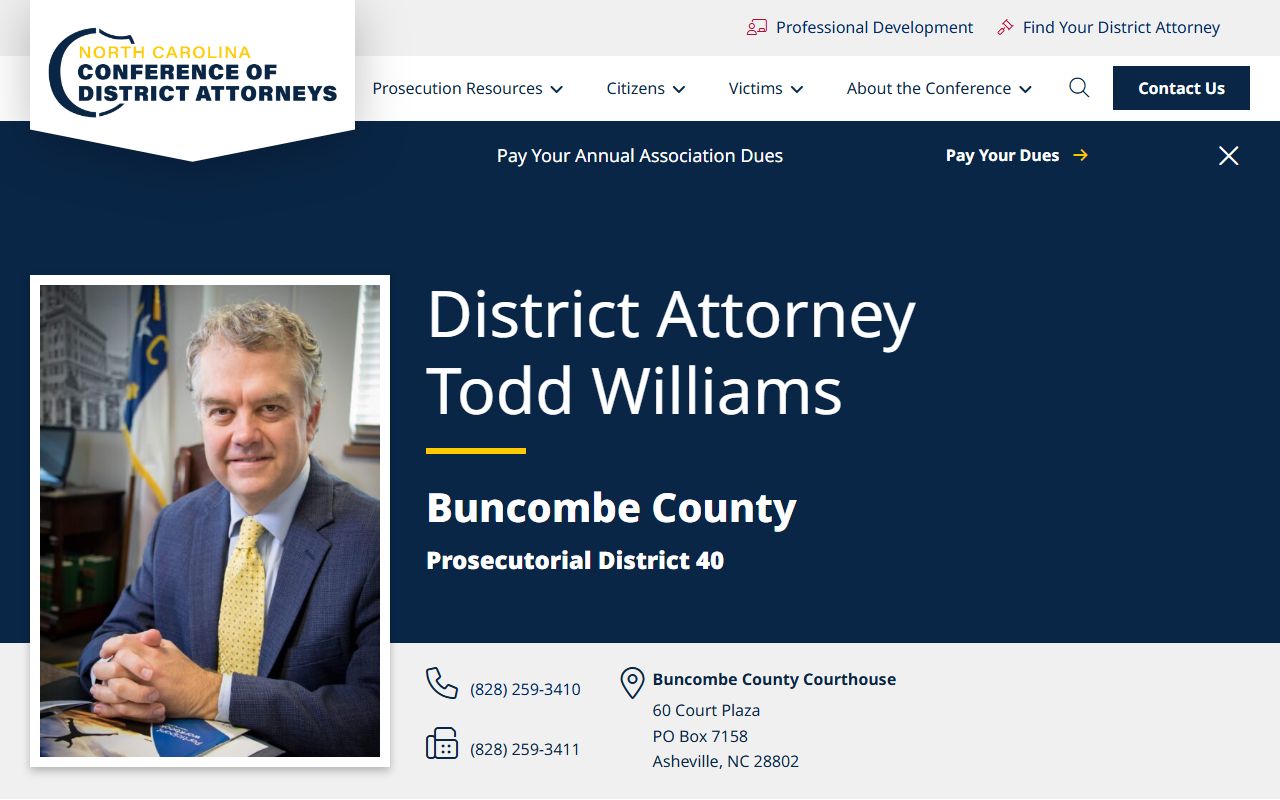
The district attorney source is relevant to criminal docket preparation and prosecution, not to clerk copy requests.
The Buncombe County District Attorney site also describes the office mission.
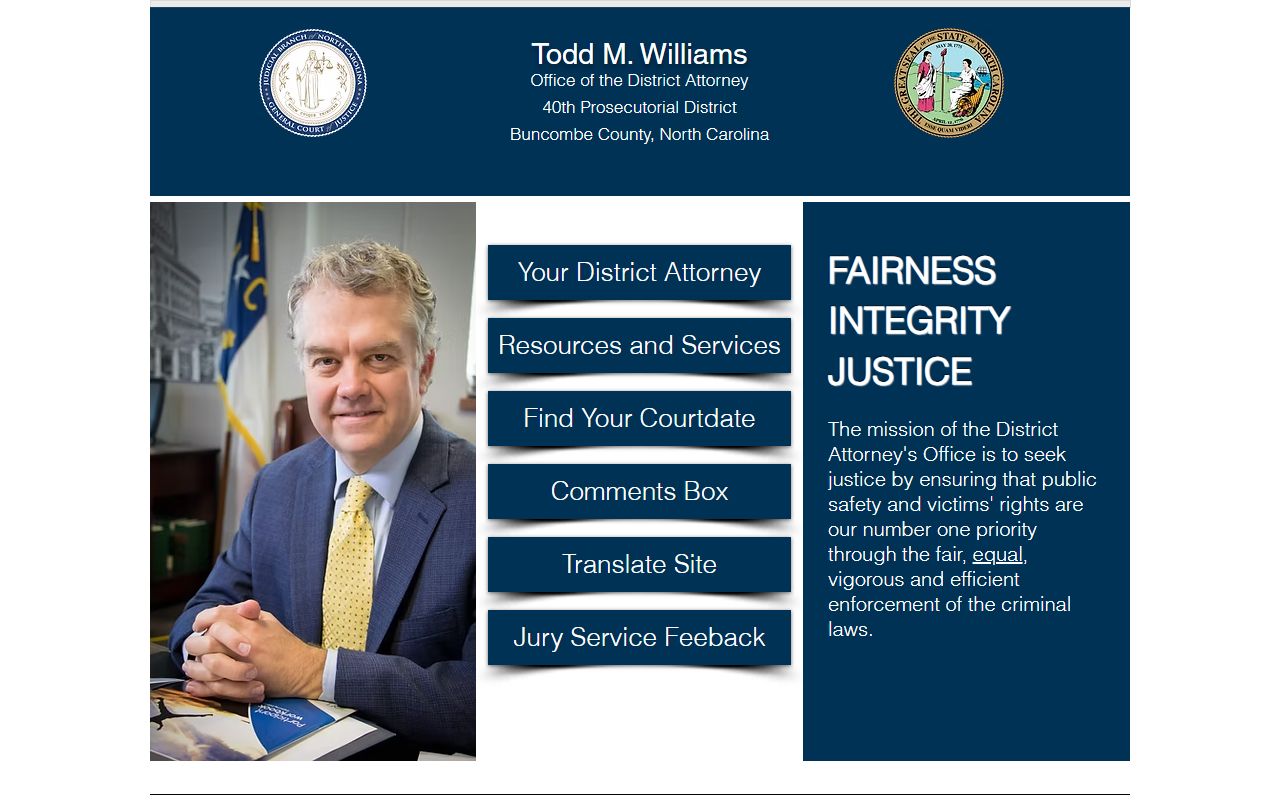
For record copies, the Clerk of Superior Court remains the file custodian even when the DA prosecuted the case.
The NC Indigent Defense Services Buncombe page lists the Public Defender contact.
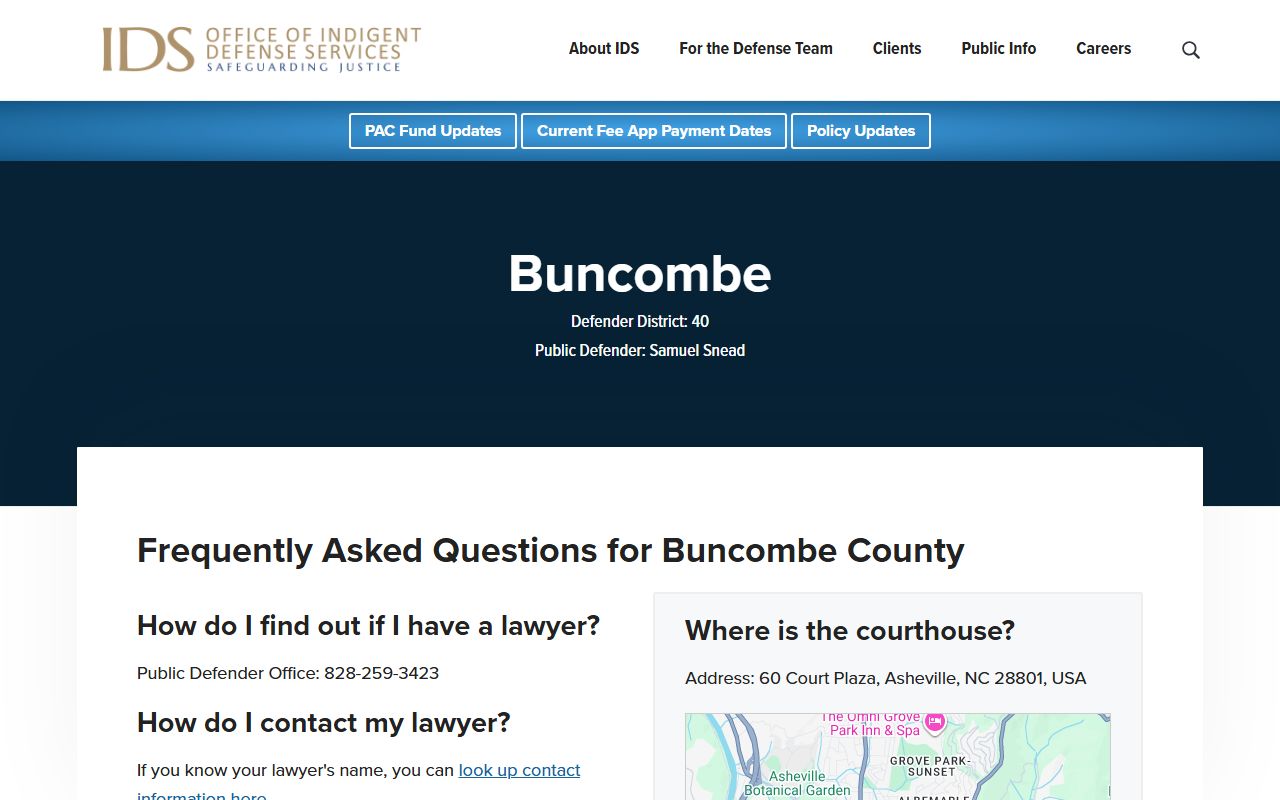
Public defender information helps identify counsel resources, but it does not replace the court record search.
Criminal Records
Clerk of Superior Court
60 Court Plaza, Asheville, NC 28801
828-259-3402
District Attorney
Prosecutorial District 40
Buncombe County
828-259-3410
Public Defender
Defender District 40
Buncombe County
828-259-3423
Buncombe Charges vs Convictions
A charge is an accusation that a criminal offense was filed. A conviction is a result that follows a guilty plea, guilty verdict, or other qualifying adjudication. A Buncombe County criminal court record can show charges that were amended, reduced, dismissed, or ended in a not guilty result. That is why the disposition and sentence fields matter as much as the charge field.
| Point | Charge | Conviction |
|---|---|---|
| Meaning | Formal accusation filed in court. | Finding or plea of guilt. |
| Record stage | Early case record and docket entries. | Disposition, judgment, and sentence entries. |
| Can change? | May be amended, reduced, dismissed, or superseded. | May lead to sentencing, appeal, or later expunction eligibility if allowed. |
| Use caution | Does not prove guilt by itself. | Read sentence, costs, probation, and appeal status for full meaning. |
Buncombe Criminal Records Limits
Public access is not unlimited. Juvenile criminal matters are restricted under Chapter 7B and are not handled like adult public criminal files. Involuntary mental health proceedings are confidential. Personal identifiers may be redacted. Sealed and expunged records can disappear from normal public views even though some agencies may retain access under statutory exceptions.
| Point | Sealed | Expunged |
|---|---|---|
| Public visibility | Restricted from ordinary public access by court rule or order. | Removed from ordinary public access after qualifying court order. |
| Common basis | Confidential case type, sensitive material, or court order. | Dismissed or not guilty charges under G.S. 15A-146, or certain nonviolent convictions under G.S. 15A-145.5. |
| Process | Access usually needs legal authority or court permission. | Petition is filed in the county where the charge was brought, unless a statute provides another path. |
| Effect | Record exists but public access is limited. | Record is removed from ordinary view, subject to statutory exceptions. |
The source image for G.S. 15A-146 appears below.
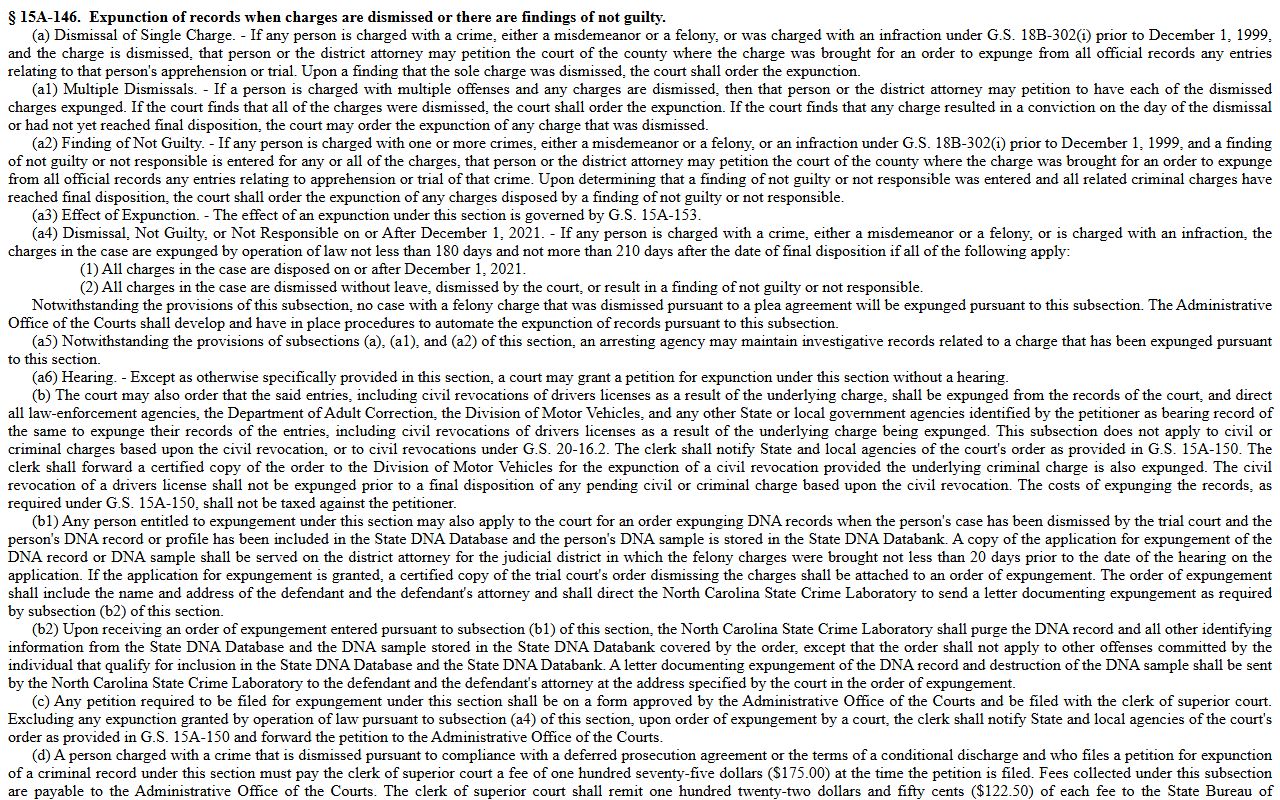
That statute is tied to dismissed and not guilty outcomes, so it should be read with the disposition field.
The source image for G.S. 15A-145.5 appears below.
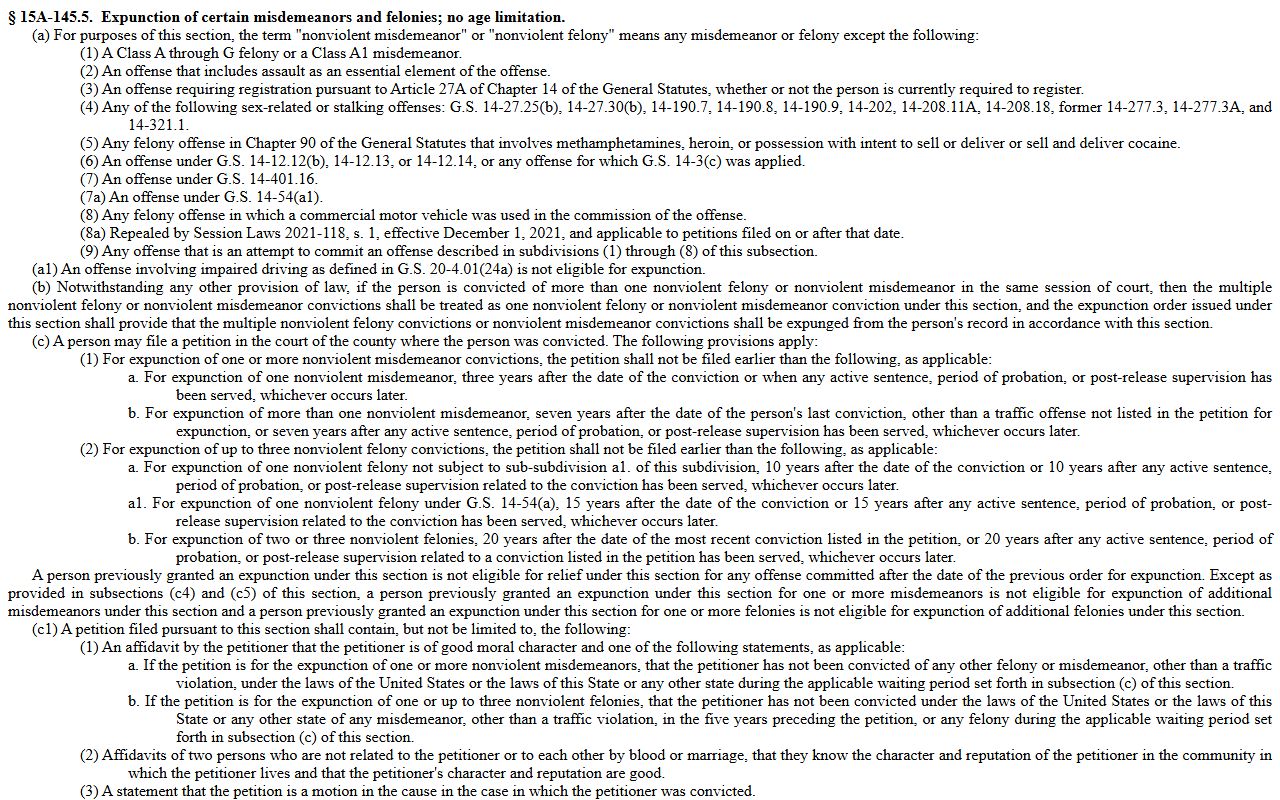
That statute applies only when its eligibility rules are met, so a conviction on the record is not enough by itself to prove eligibility.
Public Access to Buncombe Criminal Records
Public criminal case information is available through eCourts, clerk public terminals, and clerk file review, but the best channel depends on the use. For personal review or date checks, the portal may be enough. For background checks, the Judicial Branch says to use the county clerk's office rather than the portal. For certified copies, paper-file review, older files, or documents not visible online, use the Clerk of Superior Court. Note: Arrest data and jail custody data are separate from the full criminal court record.
Criminal records also intersect with jail and warrant records at specific points. A jail profile may show an arrest date, primary charge, docket number, court date, and bond status, but it will not show the complete plea, motion, disposition, sentence, and appeal history. A warrant or order for arrest may explain why a person entered custody, while the criminal court file explains how the charge moved through court.
When a Buncombe County criminal record appears incomplete online, the missing part may be a paper document, a restricted filing, an older case, or a record held by a different agency. Police reports come from the law-enforcement agency involved. Federal charges route through the Western District of North Carolina. State prison, probation, and parole records route through the Department of Adult Correction. The court file should be requested from the clerk only when the record sought is a Buncombe County court case file.